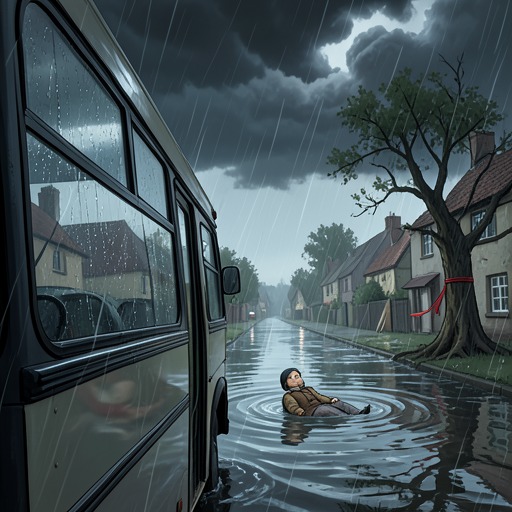
Typhoon flooding in Taitung County
Loveboat, TaipeiTyphoon flooding in Taitung County is both a physical disaster and a turning point in the Chien Tan group’s summer: its devastation reaches Ever through drowned villages and Mei-Hwa’s sudden departure, then redirects the students’ talent show into a public fundraiser. The flooding makes environmental vulnerability concrete, but it also exposes how unevenly its costs are borne and how witnessing loss can become an obligation to act.
The Flood’s Arrival and Scale
The disaster first appears through the bus window as the typhoons intensify. Rain sheets across the glass and blurs the countryside; a Puyuma village lies submerged, with only the peaks of tin roofs above muddy water. The scene is not an abstract report of bad weather: debris turns the flooded landscape into evidence of lives disrupted. An overturned rickshaw’s wheel spins in the water, dead fish show their silver undersides, and a muddy doll floats with its striped skirt fanned around her. When Debra asks whether anyone was hurt, the tour guide says no, and conversation resumes. That quick return to talk leaves the image of the village—and the uncertainty of what a disaster means for those who live there—hanging in the narrative.
The threat recurs later rather than remaining a single sight along the road. During a blackout, a hotel manager announces in Mandarin that another typhoon is over Taitung, on Taiwan’s southeast coast, and that six villages have flooded. Rick translates the announcement for Ever. The report makes the earlier image newly legible: the doll she saw in the water is no longer an isolated emblem of damage but part of a continuing emergency affecting multiple communities. When Ever asks where the families will go, Spencer replies that the tour guide has said the shoreline changes every season because typhoons continually strike the area. The scene places the immediate flood within a repeated pattern of exposure, without suggesting that recovery is simple or secure.
Mei-Hwa’s Loss and Departure
The flood enters the group’s close relationships through Mei-Hwa, whom Ever encounters in a dim hallway after the announcement. Pale yellow emergency lights fall on Mei-Hwa as she pulls a rolling bag whose worn cloth has been bound with rope. Ever recognizes in this repair the kind of thrift her mother would have practiced rather than replacing something. A practical, familiar detail thus precedes the news that Mei-Hwa is leaving: her home in Taitung has been hit, her whole village has been destroyed, and she is going back to help her parents.
Mei-Hwa’s parents and sisters are safe, but safety has not spared the family from loss. Their clothes, photographs, and furniture are gone; in her account, everything has been swept away. The flood has also damaged the conditions that let Mei-Hwa remain at school. She tells Ever that she is on a university scholarship and does not know how she can afford to stay, or how her family will survive. The crisis is therefore not only the destruction of a home and village but also the threat that material loss will sever a student from her education and make her family’s future harder to sustain.
Ever responds physically before she can solve any of those problems: she wraps her arms around Mei-Hwa as Mei-Hwa sobs and clings to her. Ever experiences the loss through an image of a stage emptied of its dancers, the joy swept away with the village. The metaphor connects the threatened lives of Mei-Hwa’s family to the work that has shaped Ever’s summer, but the embrace is not a claim that art can undo the damage. It is an act of witness and solidarity in the face of a loss Ever cannot repair on her own.
From Witnessing to Organizing Aid
The disaster also changes the purpose of a planned performance. Sophie reports that the typhoon has jammed up flights and calls the National Theater again. An acrobatic troupe from Singapore has had to cancel, opening a Friday-night slot in Taipei. Sophie has secured the opportunity for the Chien Tan talent show, persuaded Li-Han to move it and open it to the public, and learned that the theater can promote the event through its box-office windows and email list and allow admissions to be charged. She still needs the Dragon’s approval, so the plan is ambitious but not yet complete.
Ever immediately proposes directing the proceeds to Mei-Hwa’s family and the other families in her village affected by the typhoon. Rick calls it a benefit concert, giving the group a clear purpose for the newly available stage. Ever says it will be a small way to give back. That modest phrasing matters: the performance does not promise to restore houses, replace lost possessions, or settle the families’ longer-term difficulties. It turns the students’ opportunity into a practical, collective response while keeping the scale of what remains beyond their reach in view.
The benefit’s scope becomes explicit when Sophie addresses the audience at the performance. She announces that the auction has closed and that its proceeds will be announced at the end of the evening; she then offers Xavier’s mural for auction after the finale, stating that all proceeds will go to families in Taitung affected by the typhoon. The fundraiser therefore links more than ticketed performance to relief: it also makes an artwork part of the effort. The mural itself gathers images from the students’ summer, including the National Palace Museum, Sun Moon Lake, and the Taroko Gorge, whose blue and gray waters contain Asian American children and black-haired families of different ages. Xavier describes it as an analogy for the group cutting a path through rock and merging with a larger river of life. In this setting, the image’s movement toward a shared current resonates with the decision to direct the group’s work outward, toward families beyond the campus.
Public Outcome and Significance
Sophie announces the final result on behalf of the typhoon relief fund: Chien Tan has raised more than five hundred thousand NTs, or US $16,000. The sum gives the benefit a concrete outcome, and the announcement is followed by the performers’ and organizers’ exuberant embrace. The group’s celebration is not evidence that the village has been rebuilt or that Mei-Hwa’s family’s material needs have all been met; the book supplies no such resolution. Instead, it records what the students did manage to accomplish: they converted a canceled act, a public theater opportunity, their performances, and an artwork auction into substantial relief funds for affected families.
The flood’s narrative force rests on the movement between scales. The drowned village and floating doll make destruction visible from the bus; the blackout announcement identifies six flooded villages; Mei-Hwa’s rope-bound bag and account of lost possessions bring the consequences into the group’s immediate company. Her scholarship and fear for her family show how disaster can reach beyond the physical wreckage into education and livelihood. Finally, the students’ fundraiser answers the news without pretending that one evening can cancel the damage. The disaster interrupts their summer’s private ambitions, but it also gives their art a public purpose: performance becomes a means of responding to people whose losses would otherwise remain a passing view from a rain-streaked window.